
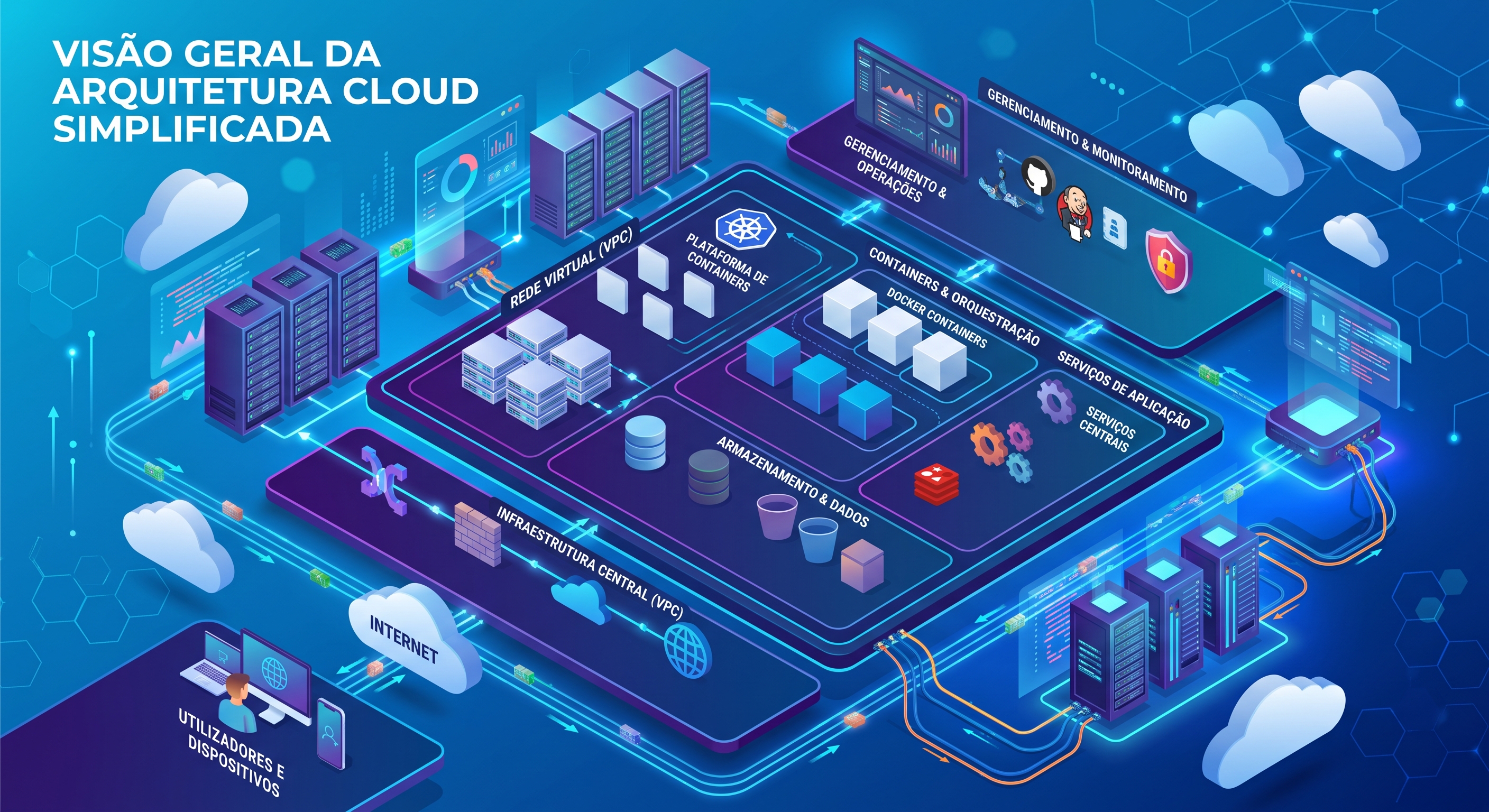
Cloud as a framework, not as a future
Quick answer: Cloud computing is no longer a technological promise for the future; it is the essential foundation of the present. Treating the cloud as a structural framework means moving away from rigid, inflexible infrastructure and building your systems on a foundation that is elastic, automated, and secure from day one. Those who still view the cloud merely as a "trend" are simply delaying modernization; the real focus today is not just on migration, but on designing efficient architectures and driving innovation directly within the cloud environment.
What does it mean to treat the cloud as a "structural framework"?
Treating the cloud as a structural framework means recognizing it as the foundation upon which applications, data, and operations are built and executed. It is not just about moving servers to a remote data center; it is about redesigning IT architecture to leverage scalability, resilience, and automation from the very start.
According to the *Panorama Cloud 2025* report, 61% of Brazilian companies already use the cloud as the primary infrastructure for their operations—not merely as a supplementary support system. This demonstrates that the cloud is an operational reality, not a distant vision for the future.
Why shouldn't the cloud be viewed as a "future" concept?
1. The window of opportunity has already closed.
Companies waiting for the "perfect moment" to migrate are losing their competitive edge. Meanwhile, competitors are already operating with cloud-native architectures, launching features faster and at a lower operational cost.
2. The cost of delay outweighs the cost of migration.
Maintaining legacy infrastructure creates hidden costs, such as hardware maintenance, the need for staff specialized in obsolete technologies, and a lack of integration with modern tools. When well-planned, the investment in migration typically pays for itself within 12–18 months through a reduction in TCO (Total Cost of Ownership).
3. AI and automation require a mature cloud environment.
The adoption of AI is placing greater demands on the cloud, effectively positioning it as the "execution layer for AI." Companies with immature cloud infrastructure are unable to extract real value from investments in artificial intelligence and machine learning.
Pillars of a cloud-first strategy
Modular and scalable architecture
Designing systems as stateless microservices allows for horizontal scaling as demand grows. This eliminates performance bottlenecks and reduces costs during periods of low utilization.
Infrastructure as Code (IaC)
Treating infrastructure as version-controlled code is an essential operational milestone. Tools such as Terraform, CloudFormation, and Pulumi enable the automated and consistent reproduction of entire environments.
Zero-Trust security
Implement rigorous access control, encryption of data at rest and in transit, and virtual network segmentation from the outset. Security cannot be an "add-on"—it must be an integral part of the architecture.
Observability and continuous monitoring
Metrics, logs, traces, and alerts should be implemented before issues arise. Proactive monitoring allows for the identification of bottlenecks, security anomalies, and opportunities for cost optimization.
Best practices for implementation
- Define business and technical requirements—including budget, timeline, and compliance constraints.
- Classify workloads and data—based on sensitivity, criticality, and regulatory category.
- Choose deployment models—public, private, hybrid, or multicloud—according to your needs.
- Automate provisioning—use IaC to ensure reproducible environments.
- Establish cost controls—utilize tagging, budgets, and monitoring to keep spending visible.
- Test before going to production—perform load testing, failover testing, and security testing.
- Document architectural decisions—use Architecture Decision Records (ADRs) and runbooks.
Use cases: when the cloud is essential
- Growing startups—decisions made in the early months directly influence the ability to scale without the need for technical rework. Companies with demand spikes—such as e-commerce, streaming, and SaaS providers—benefit from the elastic scalability of the cloud.
- Organizations with compliance requirements can leverage cloud providers that offer ready-to-use certifications (SOC2, ISO 27001, LGPD/GDPR).
- Distributed teams benefit from the cloud, which enables secure, high-performance access from any location.
Common pitfalls to avoid
1. "Lift-and-shift" without optimization
Migrating entire VMs without refactoring them for a cloud-native environment leads to higher costs and prevents the full realization of cloud benefits.
2. Lack of cost governance
Without tagging, budgets, and alerts, cloud spending can escalate rapidly. FinOps should be part of the strategy from day one.
3. Treating security as an afterthought
Implementing security only after the infrastructure is in production creates the need for rework and introduces vulnerabilities.
The future is already cloud-native
The next era of cloud computing is defined by extreme abstraction, AI-driven autonomous operations, and deep vertical specialization. Infrastructure will become entirely invisible to application developers, allowing them to focus exclusively on business logic.
Companies that treat the cloud as a foundational structure today will be well-positioned.
Conclusion: cloud right now!
The cloud is no longer a question of "if" or "when" — it is a question of "how well done." Organizations that internalize this reality and invest in cloud maturity now will reap the rewards in agility, resilience, and innovation.
Request a chat with our cloud expert →
Read also: Structured Cabling in São Paulo: 2026 technical guide, for those who still have doubts about the types of cabling your company can have.
Equipe Beltis
Especialista em tecnologia e segurança da informação