
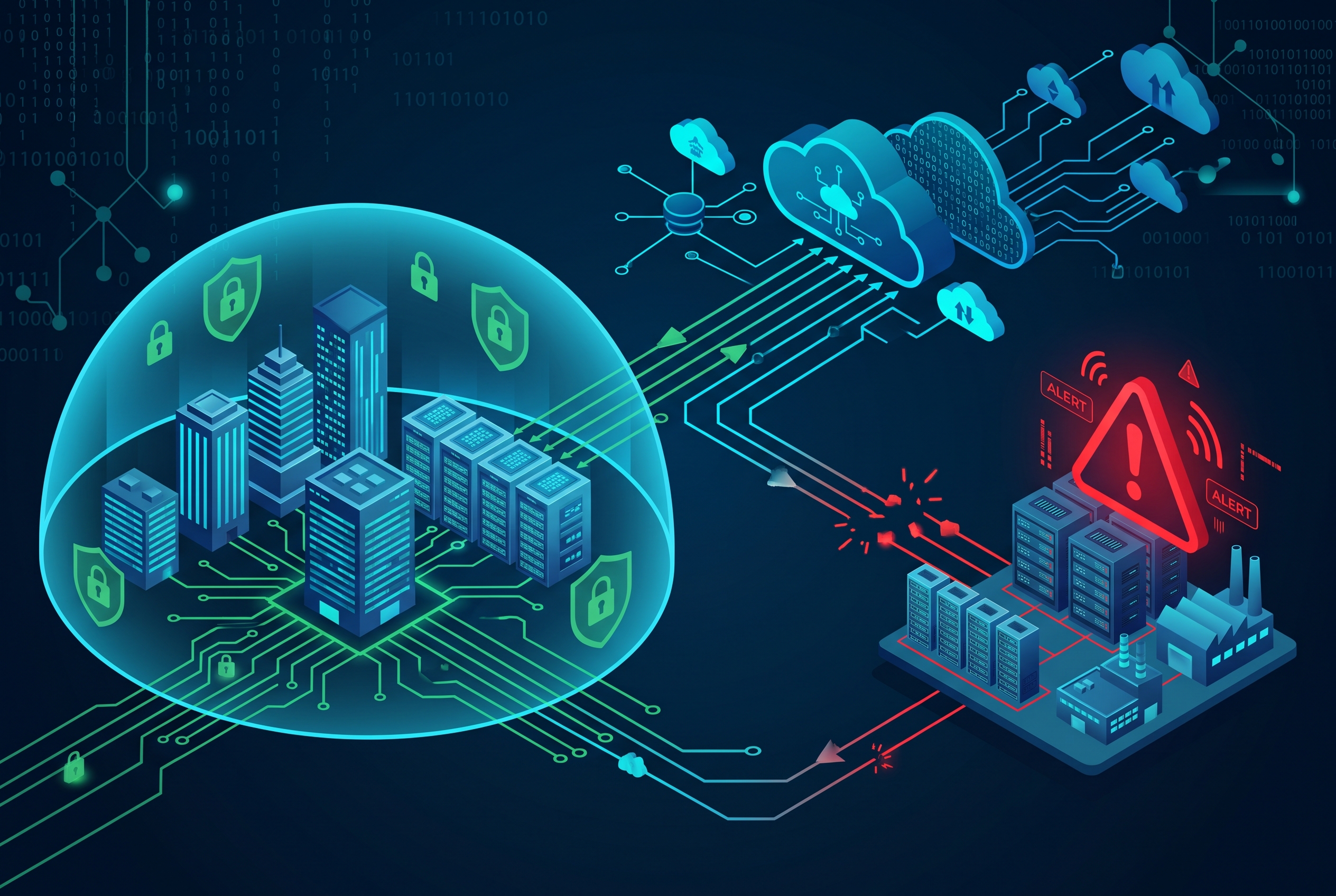
Your Company Is Armored, but What About Your Vendors? The Global Wake-Up Call of the TSMC Case
Quick Answer: Investing in perimeter security at headquarters, deploying next-generation firewalls, and conducting regular employee training do not guarantee digital immunity if your supply chain remains unshielded. The recent security incident involving global chipmaker TSMC proved that an enterprise's core on-premise systems can remain completely intact while critical business records are leaked through vulnerable servers run by third-party cloud vendors. Defending the modern corporate footprint demands extending governance far beyond headquarters: contractual compliance audits, heavily segregated cloud architectures, and strict Zero Trust policies across all third-party access paths.
The paradox of modern security: Armoring the headquarters, neglecting the supply chain
Many mid-sized and large enterprises commit the vast majority of their IT budget to on-premises defense. They deploy modern EDR agents across internal workstations, enforce multi-factor authentication, and closely inspect local activity. Leadership assumes the organization is fully safe.
Yet no modern company operates in a vacuum. Businesses sync payroll databases with SaaS platforms, transmit operational datasets to external consultancies, and integrate business workflows with numerous third-party hosting and cloud providers.
When those vendors fail to maintain identical governance standards, they become the most exposed side door into the corporate network.
Inside the TSMC incident: Data exposure without a direct breach
The TSMC incident perfectly illustrates modern enterprise threat mechanics: the semiconductor giant’s core datacenters and primary infrastructure suffered no direct intrusion or loss of integrity.
Instead, the exposure of tens of thousands of corporate employee records occurred inside a computing environment maintained by an external cloud service provider. A single misconfigured cloud bucket or over-privileged credential on the vendor's side was enough to expose confidential data belonging to the multinational client.
Incidents like this prove that adversaries rarely waste weeks hammering against hardened enterprise perimeters; they hunt for the weakest link in the digital supply chain.
4 critical errors in third-party and cloud provider management
To shield your enterprise from a similar incident, IT leaders must eliminate the four most common weak spots in vendor relationships:
- Persistent access and privilege creep: Vendors often retain administrative roles or API keys without expiration dates or scope limits, leaving doors open long after project deliverables are completed.
- Poor tenant isolation (Vulnerable Multi-Tenancy): Procuring cloud platforms where proprietary data shares compute or storage layers with unvetted tenants without end-to-end encryption.
- Absence of independent compliance audits: Entering contracts with IT providers without requiring formal compliance verifications, such as ISO certifications, SOC 2 reports, or formal data protection assessments.
- Blind trust in default cloud baselines: Assuming public hyperscalers (AWS, Azure, Google Cloud) provide total security out of the box. Cloud security operates on a shared responsibility model: hyperscalers manage physical hardware, but network architecture, identity access management, and encryption remain the direct responsibility of the client and its implementation partners.
How to insulate your enterprise against third-party risk
Extending operational defense beyond local firewalls requires structured, continuous oversight:
- Secure Cloud Architecture (Cloud Governance): Design segmented virtual networks, enforce bucket-level encryption, and implement Cloud Security Posture Management (CSPM) to flag configuration drift in real time.
- Least Privilege and Zero Trust: Never grant unconditional network trust to external partners. Vendor access must be provisioned Just-in-Time (JIT), recorded through privileged access monitors, and revoked immediately after use.
- Rigorous IT Vendor Procurement: Establish formal security intake evaluations, legally binding incident disclosure SLAs, and routine technical audits before greenlighting external system integrations.
- Continuous Monitoring and Rapid Response: Retain an around-the-clock operations team capable of detecting baseline anomalies, such as unexpected outbound data transfers between your core platforms and vendor endpoints.
Conclusion: Trust is not a security control
In today’s interconnected environment, corporate integrity and brand reputation are only as secure as the weakest vendor holding your data. Claiming that your internal perimeter has never been penetrated means nothing if proprietary assets are leaked from an unvetted third-party environment.
Auditing vendor security postures, enforcing standardized cloud baselines, and establishing rigorous digital governance are not bureaucratic hurdles—they are foundational prerequisites for operational continuity.
Discover how Beltis can structure access management and enhance cybersecurity for your company →
Read also: PHP in the Crosshairs of AI: How Automated Attacks Are Taking Down Outdated Servers and discover why automated threats demand rapid defense mechanisms and ongoing code governance.
Equipe Beltis
Especialista em tecnologia e segurança da informação