
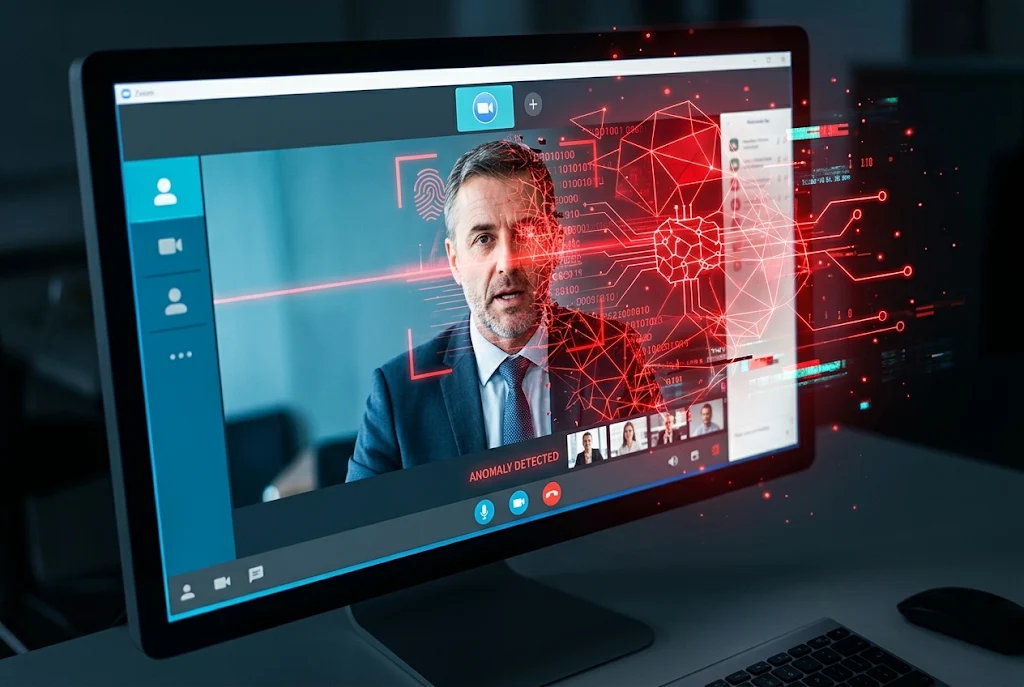
The "Executive" on the Video Call Was a Deepfake: How Real-Time AI Reshaped Corporate Fraud
Quick Answer: Seeing and hearing your colleague or direct supervisor on a remote call is no longer proof of identity. Corporate cybercrime has escalated beyond phishing emails to real-time audio and video deepfakes on platforms like Microsoft Teams, Google Meet, and Zoom. Attackers harvest brief public audio and video samples of company leadership to generate hyper-realistic digital avatars capable of interacting live, coercing finance teams and support analysts into processing wire transfers or granting privileged permissions. The only reliable defense against this attack vector is replacing informal verbal sign-offs with out-of-band verification workflows, rigid dual-control authorization matrices, and continuous Zero Trust identity governance.
The leap in social engineering: From text messages to live calls
For years, corporate awareness training taught employees to spot fraud in their inboxes: inspect sender domains, spot grammatical errors, and verify links before clicking.
With the rapid advancement of multimodal generative AI, threat actors have escalated their tactics. Global enterprises have already recorded multi-million-dollar losses in targeted attacks where staff attended video conferences alongside multiple "colleagues" and "executives" who were, in reality, synthetically generated AI avatars.
For malicious groups, generating these models has become trivial: scraping a few minutes of public presentations from podcasts, YouTube keynotes, or LinkedIn videos provides sufficient data to train voice-cloning algorithms and real-time facial puppetry engines that operate with negligible latency during an ordinary call.
The anatomy of a meeting deepfake scam
Deepfake-enabled corporate attacks follow a methodical, multi-stage structure:
- Pre-attack reconnaissance: Attackers map out the target organization's organizational chart, identifying who holds the authority to approve capital expenditures and who on the operational front line (finance or IT) executes disbursements and password resets.
- Artificial urgency and confidentiality: The video conference is convened under the premise of high confidentiality (such as an undisclosed acquisition, an urgent audit, or an emergency operational outage), actively discouraging the victim from consulting peers.
- Plausible technical degradation: To mask subtle lip-sync delays or visual edge artifacts around the face, the caller claims unstable network bandwidth or webcam hardware issues.
- Direct psychological pressure: The apparent live presence of senior leadership dramatically lowers an employee’s threshold of skepticism, prompting staff to bypass standard compliance checkpoints out of fear of hindering leadership.
Why traditional cybersecurity tools fail against real-time AI
Most enterprise security controls inspect incoming attachments, network packets, and domain reputation. However, during a deepfake conference:
- The meeting invitation is often hosted on approved corporate platforms (Teams or Zoom).
- No malicious binaries or malware are installed on the local device.
- The attack directly targets human trust and established corporate authority.
If internal company workflows allow wire transfers to be disbursed or administrative accounts to be modified solely based on a verbal nod during a video call, the security perimeter is fundamentally compromised.
How to insulate corporate operations against deepfake attacks
Protecting an organization from audio and video spoofing requires transferring trust away from human perception and embedding it into technical and operational governance processes:
1. Out-of-Band Verification
No high-impact financial transaction, vendor banking modification, or credential escalation should ever be approved solely through the channel where it was requested. If a mandate is delivered during a video call, it must be independently authenticated through a pre-established second channel (such as an in-app MFA challenge, a call back to a verified corporate mobile number, or an encrypted push notification).
2. Dual-Control Authorization Matrix and Dual Approvals
Single points of failure must be eliminated. Any fund movement exceeding predefined thresholds or any structural modification to enterprise systems must mandate cryptographic sign-offs from at least two authorized stakeholders, neutralizing the ability of attackers to coerce an isolated individual.
3. Internal Challenge-Response Protocols (Safe Words)
Executive leadership, treasury teams, and IT support desks should institute pre-shared verification phrases or challenge questions. These authenticators must be kept confidential, never recorded across open instant messaging channels, and reserved strictly for emergency verification scenarios.
4. Human Zero Trust: "Never Trust, Always Verify"
The Zero Trust paradigm extends beyond network architectures and server configurations; it must define organizational culture. Verifying an unusual request issued by an executive must not be viewed as insubordination, but embraced as the company's first line of defense.
Conclusion: Blind trust is costly
Artificial Intelligence will continue to refine the fidelity of synthetic voices and digital likenesses until distinguishing authentic video streams from computational models becomes virtually impossible for the human eye.
The sustainable solution is not expecting employees to visually detect algorithmic anomalies, but engineering operational processes so that a video call, by itself, never possesses the authority to transfer corporate capital or compromise critical company data.
Talk to our specialists about structuring access management and security for your company →
Read also: Your Company Is Armored, but What About Your Vendors? The Global Wake-Up Call of the TSMC Case, and understand why security governance must extend beyond the headquarters perimeter.
Equipe Beltis
Especialista em tecnologia e segurança da informação